Descend to Impress: Why the American Wine Cellar Now Opens the Evening
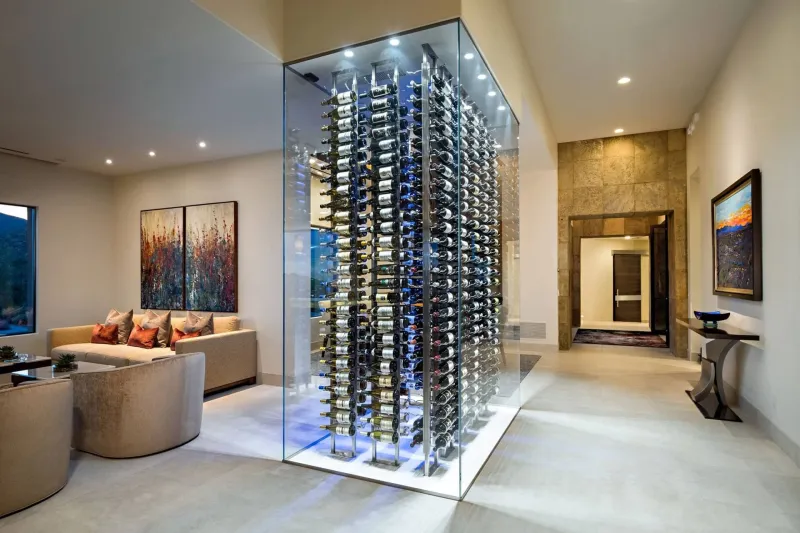
Photo: luxury glass enclosed wine cellar tasting room modern estate interior, via i.pinimg.com
There was a time when the residential wine cellar was an apology: a converted mechanical room, a rack of dusty bottles, a door you passed without a glance. That era is over. Across the country's most expensive markets, the cellar has been promoted — architecturally, socially, financially — from basement storage to the opening act of the evening itself.
Consider the sequence now common in newly built estates in Napa, Aspen, and Westchester County. Guests arrive. Cocktails are brief. Then the host suggests, almost casually, "Let me show you the cellar." What follows is a descent — often past a glass wall, across a temperature threshold, into a room engineered with the same rigor as a gallery vault. The tour is not incidental. It is choreography.
From Afterthought to Prologue
The shift is rooted in a change in how affluent Americans entertain. The formal dining room, having survived its own obituary more than once, has returned — but the evening's emotional center has migrated. Hosts want a moment of theater before dinner, and the wine room delivers it: controlled lighting, a dramatic reveal, a collection that functions as autobiography.
Designers have responded accordingly. Glass-enclosed cellars visible from the main level — sometimes behind the dining room's own walls — turn the collection into a permanent backdrop. Floor-to-ceiling panels of laminated glass maintain humidity and temperature while displaying bottles like jewelry. Tasting rooms, once a niche request, are now standard: a table for eight, dedicated stemware storage, lighting tuned to flatter both the label and the guest.
"The cellar used to be where wine went to be forgotten," says one California-based architect whose firm regularly builds estates above $15 million. "Now it's the first room we design, because the client's story starts there."
The Vault Mentality
A parallel development is the emergence of what the trade calls the collectible vault. For serious collectors — those whose holdings run well into seven figures — the cellar is less a display than a fortress. Redundant cooling systems, seismic racking in California, generator backup, and inventory systems that log every bottle's provenance and drinking window have become baseline expectations in the top tier of the market.
This is not vanity. Fine wine has matured into a recognized asset class, and appraisers have taken note. A properly engineered, glass-fronted cellar with a tasting room adds measurable value in markets where comparables exist — Napa and Sonoma most obviously, but also Aspen, where second-home buyers expect the amenity regardless of whether they drink, and the Westchester towns that line the Metro-North corridor, where pre-war homes are being retrofitted with cellars that would have astonished their original owners.
Brokers in these markets report that a statement wine room functions as a differentiator in a way that, say, a home theater no longer does. The cinema has been commodified. The cellar has not — because no two collections are alike.
What the Best Designers Are Building
The current vanguard favors several moves. First, the visible cellar: glass volumes placed where daily life happens, not hidden below grade. Second, the experiential threshold — a transition of material and temperature, often a heavy door or a descent in stone, that signals arrival. Third, the tasting room as destination: fireplaces, art, acoustics handled with the same care as the primary suite.
Materials have evolved, too. Custom steel and glass racking, travertine and monolithic stone floors, and integrated LED coves have displaced the rustic brick-and-barrel aesthetic of the 2000s. The look is closer to a Sotheby's viewing room than a tavern.
Even in retrofits, where excavation is costly, designers are finding room — under garages, beside home wellness wings, adjacent to the catering kitchens that already occupy the basement's service corridor. The cellar, it turns out, fits neatly into the backstage economy of the modern luxury home.
The Deal-Making Room
Which returns us to the boardroom comparison. Real estate agents and their clients have noticed something about the cellar's social physics: it removes hierarchy. There is no head of the table, no screens, no interruptions. The setting does the flattering. Bottles open conversations that dining rooms cannot.
Whether or not a handshake over a Barolo is more binding than one over a conference table, the perception matters. In a market where every amenity competes for square footage and every room must justify itself, the wine cellar has made its case. It is no longer where the collection sleeps. It is where the evening — and sometimes the deal — begins.