Before the Kitchen, the Garage: Inside Luxury Real Estate's Newest Showpiece
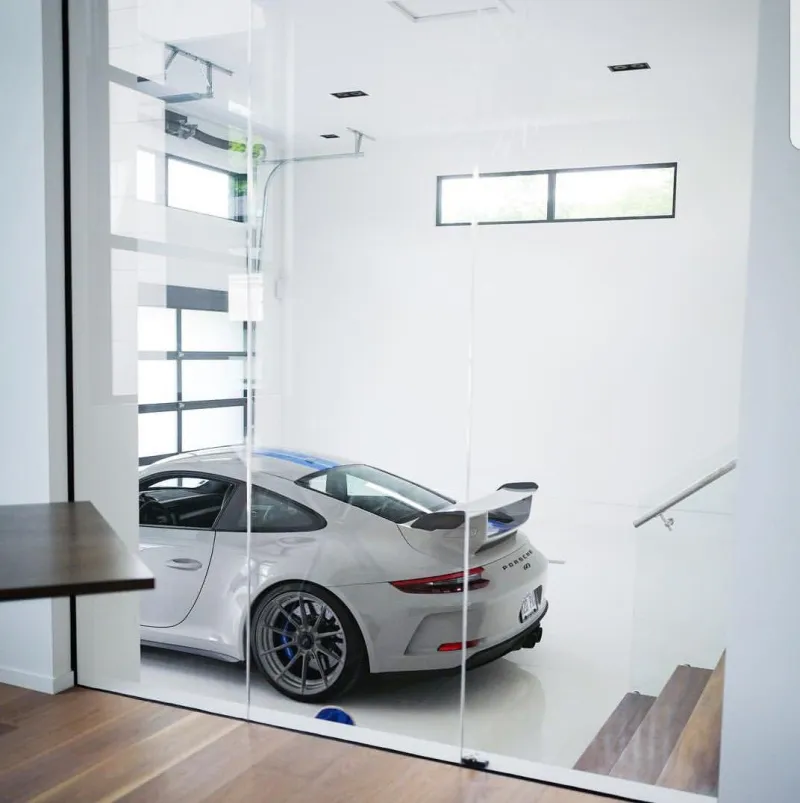
Photo: luxury modern garage with sports cars glass wall interior, via i.pinimg.com
There was a time when the garage was the room real estate agents hurried past. It was listed in square footage, mentioned in passing, and rendered in the same flat gray on every floor plan. Today, in the upper reaches of the American housing market, the sequence has inverted entirely: buyers are touring the garage before the kitchen, and in some transactions, the garage is the reason the tour happens at all.
From Afterthought to Architectural Statement
The numbers tell part of the story. High-specification residential garages now routinely run between $200 and $700 per square foot, with fully bespoke installations — car turntables, glazed walls, mezzanine lounges — crossing well into six figures. In markets like Scottsdale, Miami, and the hills above Los Angeles, listings increasingly lead with phrases such as "gallery garage" and "motor court" rather than burying the parking count in the spec sheet.
What has changed is not merely the budget but the ambition. The contemporary luxury garage borrows its vocabulary from the museum: polished terrazzo or epoxy floors, museum-grade lighting calibrated to flatter automotive paint, and climate systems that hold temperature and humidity within narrow tolerances. Detailing bays with dedicated water filtration and compressed-air lines have become expected. Some owners commission vehicle turntables — a fixture once reserved for Swiss showrooms — so a prized car can rotate slowly behind a glass wall, visible from the living room like sculpture on a plinth.
The Glass-Walled Motor Court
Architecturally, the most visible trend is transparency. Where garages were once deliberately recessed and concealed, architects now frame them as part of the arrival sequence: floor-to-ceiling glazing, pivot doors in rift-sawn oak, and motor courts that present the collection to visitors before they reach the front door. In Palm Springs and the desert resorts of Arizona, midcentury-inspired carports with dramatic cantilevered roofs have returned to favor, their open frames turning automobiles into permanent exhibits.
This visibility is deliberate. The automobile, for a certain class of collector, has rejoined the category of art — and art demands a gallery. Builders report that collectors now specify garage dimensions around the turning radius of a particular chassis, with ceiling heights engineered for vehicle lifts and column placement negotiated around door-opening arcs.
What It Does to the Price
Appraisers remain cautious — a turntable does not carry the same valuation weight as a renovated kitchen — but the market signal is unmistakable. In competitive enclaves, a finished, climate-controlled garage of consequence can shorten days on market measurably and, in collector-heavy geographies, add a genuine premium. More importantly, it functions as a filter: the buyer who asks detailed questions about floor load capacity and ventilation is the buyer prepared to transact.
Agents describe a new choreography to showings. Prospective purchasers of $8 million homes frequently walk the motor court first, assessing not just storage but the seriousness of the house itself. A neglected garage, they note, reads like an unfinished sentence.
Why the Shift Happened
Several currents converge here. The pandemic-era investment in the home extended to every auxiliary space — wine rooms, wellness floors, basement theaters — and the garage was the last unrenovated room standing. Simultaneously, car collecting has broadened among younger affluent buyers who treat vehicles as assets and aesthetics rather than mere transportation. And the luxury market's broader appetite for display — the glass wine wall, the visible pantry, the sculptural stair — naturally extended to the one room built to hold the most photogenic objects owners possess.
There is also a quieter logic: unlike a wine cellar or a home theater, a well-designed garage serves daily. It is luxury that greets the owner every morning and again every evening, which may be the most persuasive argument of all.
The Bottom Line
For buyers and sellers alike, the lesson is the same. The garage is no longer the room to deprioritize. In America's finest homes, it has become a stage — and increasingly, the first act of the showing.