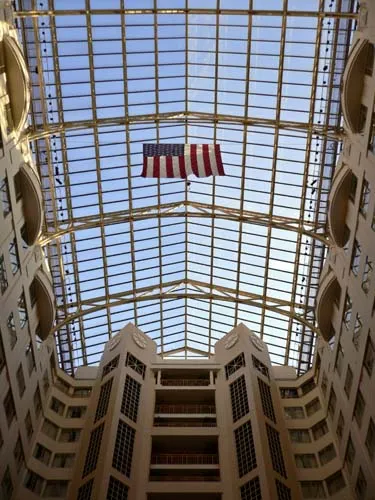
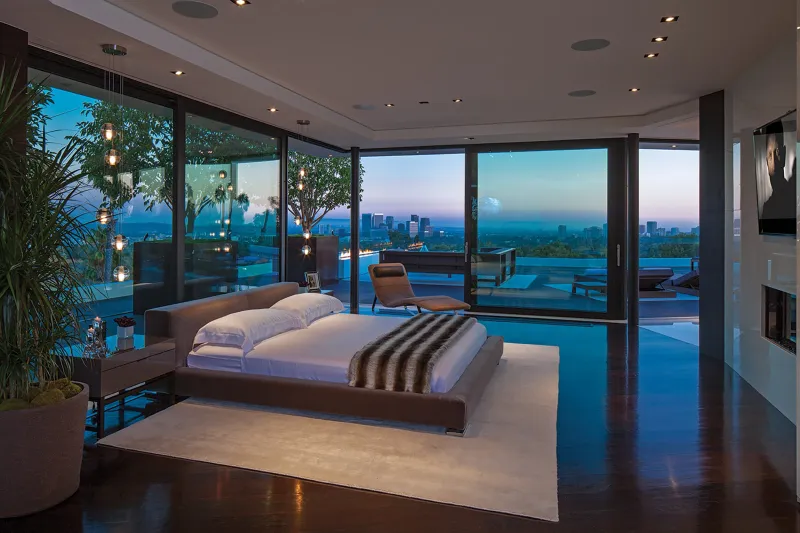
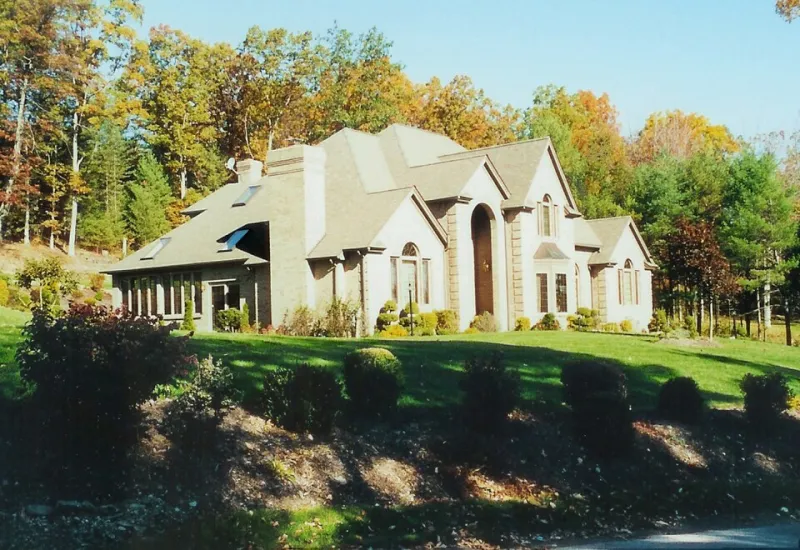
Overhead Ambition: The Ceiling Has Become Luxury's Most persuasive Surface
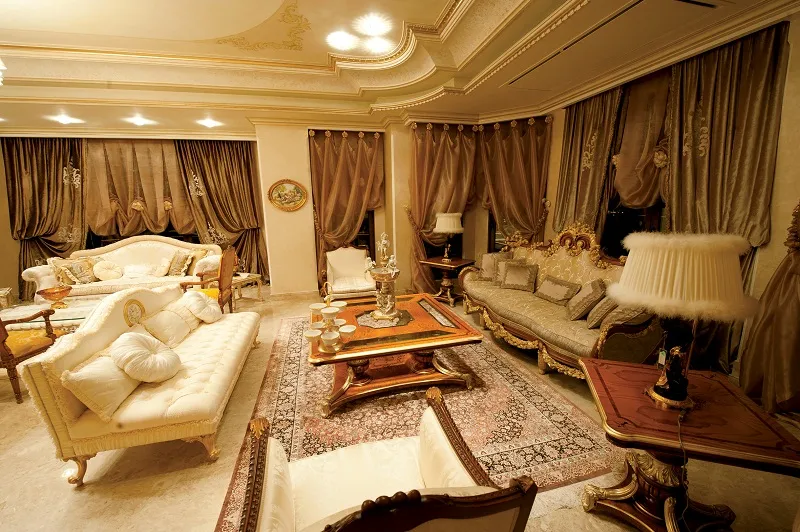
Photo: Fast Track Commercial, CC BY-SA 3.0, via Wikimedia Commons
Walk through enough multimillion-dollar listings and a pattern emerges. The marble islands blur together. The wide-plank oak floors become indistinguishable. What separates a memorable residence from a well-executed one increasingly lives eight to twelve feet overhead.
Architects have a name for this quiet revolution: the fifth wall. And in 2025, it is no longer a designer's inside joke. It is a line item, a selling point, and in some of the country's most competitive markets, the reason a listing photograph stops a scroll.
From Afterthought to Anchor
The history of the neglected ceiling is a history of convenience. Postwar tract building standardized eight-foot flat planes because they were cheap to frame and cheap to drywall. Even as luxury budgets soared, the ceiling remained the last surface to receive serious attention — a blank white field punctuated by a grid of recessed cans that critics have long dismissed as "swiss cheese."
That consensus has cracked. A new generation of architects, many trained in the detail-obsessed traditions of West Coast modernism and East Coast classical revival, now treat the overhead plane as the room's compositional anchor rather than its termination.
"We stopped thinking of the ceiling as the end of the wall and started thinking of it as the beginning of the room," one Los Angeles-based architect told us, describing a Bel Air project where a vaulted plaster ceiling, hand-troweled to a soft undulation, does more visual work than any piece of furniture below it.
The Plaster Revival
No material embodies the shift more clearly than plaster. Lime and gypsum finishes — troweled by hand, often in multiple passes — have returned to high-end residential work after decades in exile. The appeal is tactile and optical at once: plaster absorbs and diffuses light in a way painted drywall never can, lending rooms a softness that photographs as warmth.
In recently listed homes from Santa Fe to Charleston, vaulted plaster ceilings appear with striking frequency. Some are smooth as eggshell; others carry the gentle irregularity of the artisan's stroke. Either way, the message to a prospective buyer is the same: someone here cared about the part of the room you almost never touch.
The economics are not trivial. Hand-applied plaster can run several times the cost of a standard paint job, which is precisely the point. It is a legible signal of craft — the architectural equivalent of a savile-row lapel.
Coffered Confidence, Reconsidered
The coffered ceiling, long the province of traditional great rooms and golf-club libraries, has also been reinterpreted. The new coffers are often minimal — shallow steel beams, crisp plaster beams, or wood ribbons that run unbroken from interior to exterior soffit. In a Napa Valley estate listed this spring, whitewashed oak beams continue through retracting glass walls, dissolving the boundary between great room and terrace.
Done poorly, coffers read as theme-park traditionalism. Done well, they impose rhythm and scale on large volumes, making a 30-foot room feel composed rather than cavernous. The distinction, architects say, comes down to proportion — a discipline that separates the merely expensive from the genuinely designed.
Light as Architecture
The other transformation is quieter: the death of the recessed can as default. In its place, designers deploy cove lighting, integrated slots, and concealed linear fixtures that wash a plaster vault or graze a wood soffit. The fixture disappears; the effect remains.
This is lighting treated as architecture rather than accessory. A well-detailed cove can make a ceiling appear to float, or turn a hallway into a gallery of soft gradients. In evening showing hours — increasingly how luxury homes are marketed — these details carry disproportionate weight. A room that photographs beautifully at noon and glows at dusk is a room that sells.
The Listing Advantage
Brokers have noticed. Listing copy that once celebrated "soaring ceilings" now names finishes: Venetian plaster, white oak ceilings, steel-framed skylights. Drone and gimbal photography has made overhead drama easy to capture, and buyers raised on architectural Instagram have learned to read it.
The fifth wall, in other words, has become a language of value. It signals budget spent where only the attentive will notice — a subtler form of luxury than a car gallery or a wine wall, and arguably a more enduring one.
For homeowners contemplating a renovation, the lesson is accessible even at modest scale: paint the ceiling a considered color, add a single plaster detail, replace a grid of cans with one well-placed cove. The room will read differently. The eye, given something worthy above, always looks up.