A Wall That Wasn't: The Quiet Prestige of the Concealed Passage
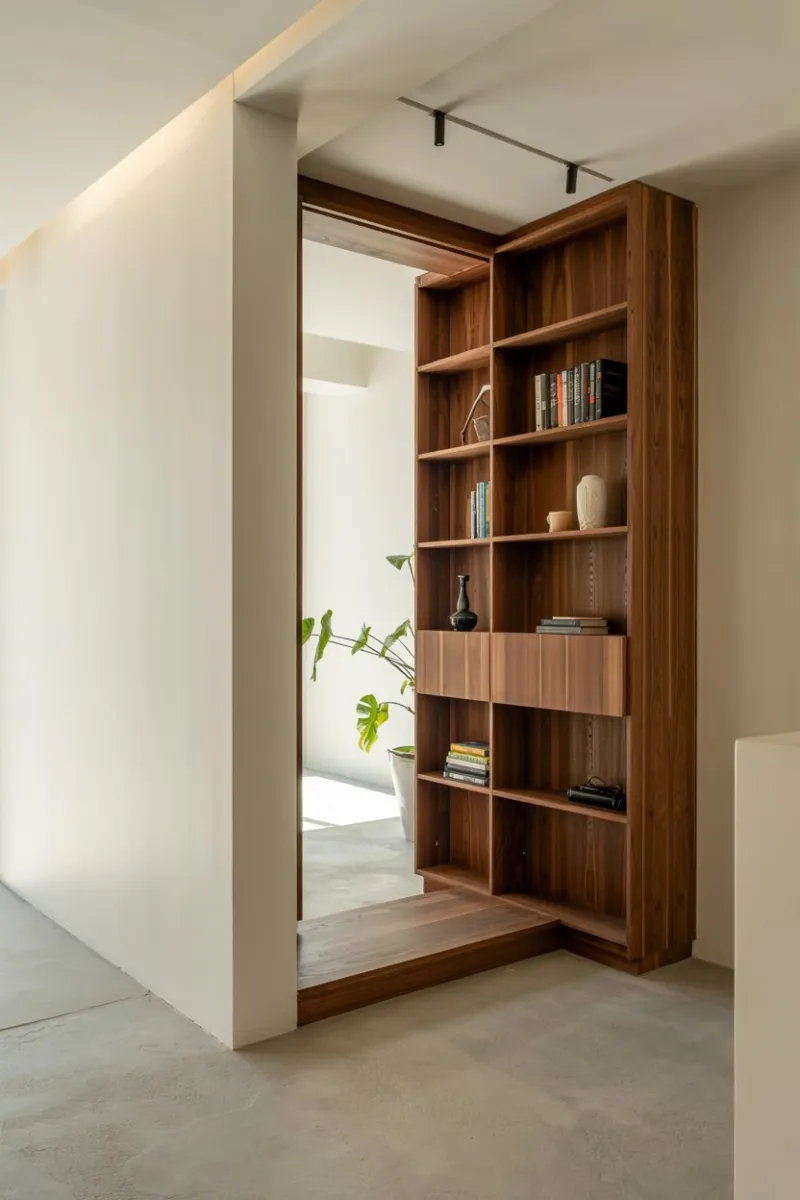
Photo: hidden bookshelf door luxury home interior white oak panel, via alanmossny.com
There is a moment familiar to anyone who has toured a newly completed estate in Greenwich, Aspen, or Montecito. The host pauses beside what appears to be a paneled wall — flawlessly jointed white oak, perhaps, or hand-plastered to a soft matte finish — touches a spot invisible to the eye, and a door the size of a barn opening swings silently inward. Behind it: a screening room, a private study, a stair to a vault. The gesture is theatrical, and yet the entire point is that there should be no theater at all.
The concealed passage has moved from novelty to near-requirement in high-end American residential work. Its rise says something about where luxury is headed — and about the particular kind of buyer who now shapes it.
The Economics of Disappearance
A well-executed hidden door is among the most expensive ways to move between two rooms. Concealed hinge systems engineered in Germany and Switzerland, precision-matched millwork, drywall and plaster crews skilled enough to make a seam vanish — the cost routinely runs ten to twenty times that of a conventional door of the same size. A flush, book-matched panel that pivots on a concealed axis can easily command a five-figure price before finish hardware is even discussed.
That expense is precisely the point. Visible luxury — the marble island, the statement chandelier — is legible to everyone, including those who cannot afford it. A door you cannot find is legible only to those who have been invited past it. It is privacy rendered in millwork, and it cannot be photographed for a listing. In a market increasingly wary of overshares, the unphotographable amenity carries its own currency.
The Specialists of the Vanishing Act
A small cohort of American firms has built reputations on making things go away. Millwork shops in the Carolinas and the Pacific Northwest now derive a meaningful share of their business from concealment packages — pivot doors, bookcase entries, murphy-style panels that swallow televisions and, occasionally, entire bars. Architects who once treated the hidden door as a whimsical request now budget for one in nearly every estate-scale commission.
The technical demands are unforgiving. A pivoting panel weighing several hundred pounds must close with a whisper and sit dead-flush with its neighbors, season after season, as houses in climates like Minnesota's and Texas's breathe and settle. Achieving that consistency requires tolerances closer to furniture-making than to framing. It is one reason the best hidden doors are ordered early and installed late — after the house has done most of its moving.
A Very Old Idea, Quietly Returned
None of this is new. concealed passages are among the oldest gestures in residential architecture — the priest hole, the servants' stair, the speakeasy door. What has changed is the rationale. Earlier generations hid rooms for safety, piety, or prohibition-era refreshment. Today's hidden door hides nothing so dramatic. It conceals a media room, a wellness suite, a home office where the household's affairs are conducted away from guests and, more to the point, away from cameras.
The contemporary version is also more architectural than its ancestors. Rather than a creaking bookcase, designers favor the full-height flush panel — a wall that simply ceases to be a wall. The effect aligns with the broader move toward quiet, unbroken surfaces in American luxury interiors: continuous stone, concealed kitchens, flush cabinetry. The hidden door is simply that aesthetic taken to its logical conclusion.
What the Hidden Door Says
Every era's luxury signals its values. The Gilded Age announced itself in carved staircases and ballrooms; the late twentieth century in home theaters and infinity pools. The current generation of buyers — often founders, often private by temperament, frequently burned by visibility — is drawn to features that cannot be searched, listed, or envied at scale.
The hidden door is that impulse made physical. It promises that the house holds more than it shows, that the owner controls what is seen and what is withheld. In American real estate, where the impulse has always been to display, restraint has become the rarest material of all — and a door you cannot find is its most elegant expression.