The Seven-Figure Ascent: What a Sculptural Stair Reveals About a House
In the American luxury house, the staircase has shed its role as mere circulation and assumed a more demanding one: structural sculpture, lighting instrument, and spatial promise. In 2026, the most ambitious residences in Los Angeles, New York, Miami, and Aspen are as likely to be organized around a stair as around a kitchen island. The result is a vertical arms race in which a single flight can carry a budget once reserved for a professional-grade kitchen, and can reveal more about a project's discipline than any appliance package.
From Circulation to Centerpiece
For decades, the American stair was often treated as a problem to be solved: tucked behind a wall, compressed into a switchback, or hidden behind a powder room. The open-plan era changed that calculation. Once the ground floor became a continuous field of living, dining, and cooking, the stair became one of the few vertical elements capable of giving a large volume a center of gravity. Architects began to pull it forward, widen its landings, and treat its underside as a ceiling in its own right. In the finest recent work, the stair is not simply visible from the foyer. It is the foyer's reason for being.
That shift has consequences. A stair meant to be seen must be detailed for close inspection. The reveal at a tread, the shadow gap at a stringer, and the alignment of a glass panel are no longer secondary conditions. They are the design. A homeowner who has paid for a sculptural stair is paying for tolerances measured in millimeters, not merely for a dramatic silhouette.
The Engineering Behind the Silhouette
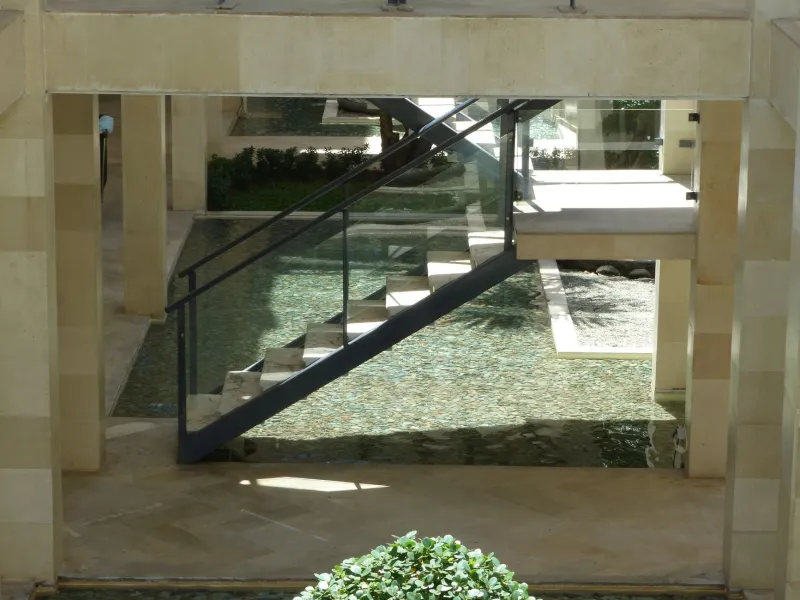
Cantilevered stone treads appear effortless because the effort has been moved into steel, concrete, or a concealed spine. A limestone tread that seems to float is usually anchored to a steel armature or a reinforced wall, with each connection calculated for dead load, live load, and the subtle dynamics of human movement. Deflection and vibration matter as much as strength. A stair that feels solid underfoot reassures the body before the eye has time to judge the design.
Glass balustrades add another layer of complexity. Structural glass must resist impact and lateral pressure while remaining optically calm. The fittings that hold it in place are often the most expensive small components in the house. Integrated lighting introduces yet another discipline: the fixture must disappear, the beam must graze the tread without glare, and the driver must be serviceable without opening a finished wall. On the best projects, the architect, structural engineer, lighting designer, stone fabricator, and millworker are in conversation before the foundation is poured.
What Seven Figures Actually Buys
The price of a seven-figure stair is rarely explained by stone alone. It is explained by the invisible work: off-site fabrication, mock-ups, temporary supports, crane access, installation tolerances, acoustic isolation, and the coordination required to make a heavy object behave like a light one. A single curved flight may require a steel spine fabricated in sections, a stone supplier capable of book-matching slabs, and a installer willing to work at height without damaging adjacent finishes.
Acoustics are part of the bill. A hard stair in a hard foyer can amplify every footstep into a household announcement. The better solutions isolate the structure, soften the landing, and tune the surrounding room so that the stair sounds as composed as it looks. None of this appears in the listing photograph, but all of it appears in daily life.
Judging a Stair Beyond the Photograph
Buyers should ascend and descend without music, without staging, and without distraction. The handrail should feel temperate and continuous. The tread should feel stable at the nose, not merely at the center. The lighting should reveal the edge of each step without throwing glare into the eye. The guardrail should meet code without looking like an afterthought. The underside should be finished as carefully as the top, because guests will see it from below.
The most revealing test is sound. A well-resolved stair absorbs the blow of a heel and returns a muted, solid note. A poorly resolved stair rings, creaks, or transmits vibration into adjacent walls. That difference is not cosmetic. It is the difference between a sculpture and a working part of the house.
The Responsibilities of a Vertical Signature
A sculptural stair is a legitimate luxury, but it is also a long-term obligation. Stone requires maintenance. Glass requires cleaning. Integrated lighting requires access. A cantilevered flight requires an engineer's records and a fabricator who can be called back. The finest examples accept those obligations openly, because they are designed as permanent architecture rather than temporary spectacle.
Not every house needs a seven-figure ascent. But every house that has one should be judged by how it performs when no one is photographing it. The stair is the rare luxury object that residents touch every day, at speed, in the dark, and underfoot. That is why it has become one of the most honest measures of a house's ambition—and of the discipline behind it.