Priced by the Postcode: The Invisible Economics of What American Buyers Really Pay For
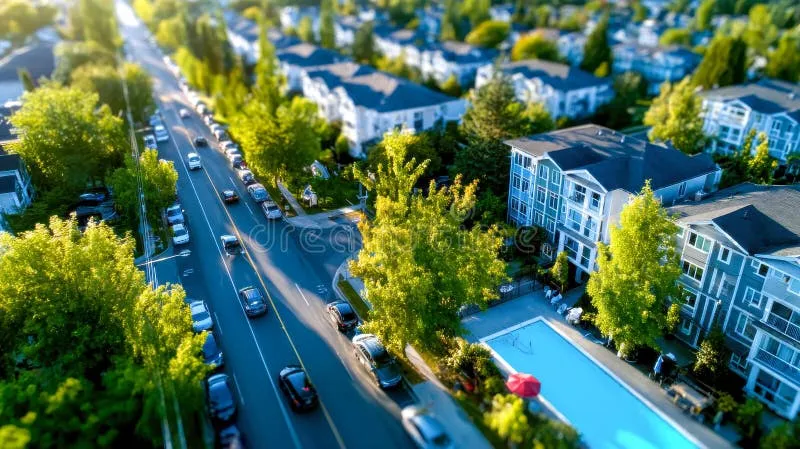
Photo: luxury suburban corner house tree-lined street aerial view, via thumbs.dreamstime.com
Two houses stand six blocks apart in the same coastal California town. Both were built in the same decade, both hold roughly 4,200 square feet, both carry pools and respectable finishes. One sold last spring for $3.1 million. The other fetched $4.6 million. The difference was not architecture, not acreage, and not water. It was a corner position on a quiet lane, a protected view corridor through neighboring trees, and a street address that appraisers in the region describe, without irony, as 'blue-chip.'
American real estate has always traded in intangibles, but the spread between what a house is and where a house is has widened into something approaching a parallel market. Understanding which location premiums are real — and which are folklore — has become one of the most consequential skills a buyer can possess.
The Corner Lot Paradox
Conventional wisdom holds that water frontage is the apex premium, and in most markets it remains so. But among lots without water, the corner position has quietly become the most reliably monetized feature in American residential appraisal. Appraisers attribute this to a cluster of effects that arrive together: wider setbacks, more light exposure, dual frontage for landscaping, and a psychological read — fair or not — of prominence.
The paradox is that corners also carry costs. More exterior wall means more maintenance, more noise exposure, and, in some municipalities, higher setback requirements that shrink usable yard. Yet in premium markets from Fairfield County to North Dallas, corner transactions consistently clear five to twelve percent above interior equivalents on the same street. The market is not pricing maintenance. It is pricing arrival.
Cul-de-sacs and the Premium of the Dead End
Few features illustrate the strangeness of address economics better than the cul-de-sac. Traffic engineers have largely turned against them, citing connectivity and emergency response times. Urban planners argue they fragment neighborhoods. None of that has mattered to the market.
A cul-de-sac parcel routinely commands a premium of ten to twenty percent over a comparable lot on a through street, driven almost entirely by the absence of cut-through traffic and the semi-private feel of the turn-around. In suburban Atlanta, Phoenix, and the outer rings of Chicago, the premium has proven durable across market cycles — rising in booms, holding in corrections. Buyers are not purchasing a street design. They are purchasing a guarantee that no one will ever drive fast past their front door.
What the Street Name Is Worth
Appraisal folklore holds that names influence value, and the data increasingly supports it. Analysis of sales records in multiple metros shows measurable premiums on streets named for trees — Live Oak, Cedar, Willow — compared to numbered streets or thoroughfares with arterial designations. 'Lane,' 'Cove,' and 'Way' outperform 'Street' and 'Avenue' by margins that persist even when controlling for lot size and vintage.
The mechanism is not irrational. Street type signals density: a 'Way' is unlikely to become a commuter route, and buyers understand this instinctively before they ever read a traffic study. The name functions as compressed information about noise, speed, and permanence.
The Myths That Do Not Hold
For every durable premium, there is a fashionable one that dissolves under scrutiny. Listing agents interviewed across three markets pointed to several recurring examples:
- The golf course premium is shrinking. Once a reliable fifteen percent uplift, adjacency to courses now trades at a discount in some markets, as maintenance dues, herbicide concerns, and declining play compress demand.
- The 'good side of the street' is mostly noise. Sun orientation matters for light, but the north-versus-south side of a suburban street rarely moves price once appraisers adjust for it.
- School district lines are real, but bounded. The premium is enormous across a district line and nearly zero within it — a step function, not a gradient, which savvy buyers exploit by shopping the interior streets of strong districts.
What This Means for the Buyer of Consequence
For affluent purchasers, the practical lesson is to invert the usual order of evaluation. Square footage is the most liquid, most reproducible, least differentiated attribute of a luxury home — it can be added by an architect. Location premiums, by contrast, are largely fixed. A view corridor protected by zoning, a corner position on a low-traffic lane, a street name with three decades of comparable sales behind it: these cannot be renovated into existence.
The appraisal profession's own guidance reflects this hierarchy. Adjustments for condition and finishes are routine and granular; adjustments for location are the widest and least certain on any grid. Uncertainty, in valuation as in investing, cuts both ways — and it is precisely where disciplined buyers find their edge.
The house at $4.6 million and the house at $3.1 million differ by six blocks and a set of intangibles. One of them is likely to keep compounding. The other is likely to be renovated, re-listed, and re-priced against its neighbors. In American luxury property, the address has never been a footnote to the architecture. Increasingly, it is the architecture's silent co-author.