The Smallest Stage: How the Powder Room Became Luxury’s Most Concentrated Design Statement
There is a particular kind of confidence in a house that spends its boldest gesture on a room almost no one will use for more than three minutes. The powder room has become that gesture. Long treated as a utility closet with a sink, it is now one of the most closely designed spaces in the American luxury home—a small, self-contained stage where materials and lighting are allowed to be more dramatic, more personal, and more expensive than they might be in a larger room.
The Room That Must Perform
The powder room has a simple program: a toilet, a sink, a mirror, a light. But its social role is more complicated. It is the room guests enter alone, close the door, and inspect without distraction. They see the stone edge, the wallpaper repeat, the hinge, the water pressure, the placement of the towel. In a house full of large, carefully managed spaces, the powder room is the one place where the design is experienced at close range.
That intimacy explains why architects and interior designers now treat it as a signature moment. It is small enough to permit risk. A bold marble may be too much for a living room but exactly right for a powder room. A dark lacquered ceiling may feel oppressive in a hall but glamorous in a room the size of a closet. The powder room absorbs experimentation because it is brief.
Stone, Light, and the Discipline of Scale
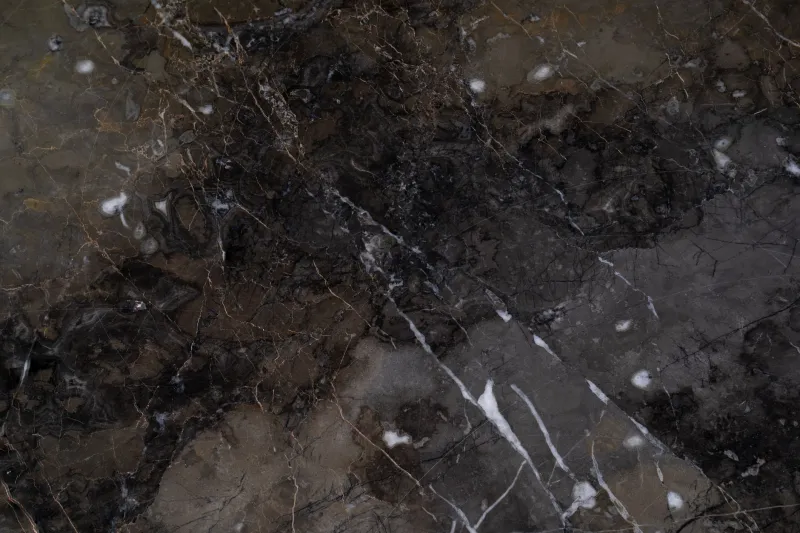
The most visible shift is the use of stone. A single slab may run from floor to wall, its veining treated like a painting. Book-matched marble can make a tiny room feel deliberate and expensive without requiring a large quantity of material. Some designers use a contrasting stone for the floor, or a thick slab for the sink surround, to give the room a sense of weight.
Lighting is equally important. A powder room cannot rely on daylight, so every fixture is a decision. Sconces may be placed low to cast flattering light. A pendant may be treated as jewelry. Recessed lighting may be kept dim and warm. The goal is not brightness but atmosphere—enough light to see the details, not so much that the room feels clinical.
Scale is the discipline that keeps these choices from becoming a collage. A small room can handle strong materials if the proportions are calm. A floating vanity, a recessed mirror, a slim towel bar, and a single piece of art may be enough. The best powder rooms feel inevitable rather than packed.
Wallpaper, Art, and the Collected Guest
Wallpaper has returned to the powder room with particular force. Because the room is small, a bold pattern can be used without overwhelming the house. Chinoiserie, geometric prints, grasscloth, and hand-painted scenes all appear in contemporary luxury work. The wallpaper may set the color story for the room, or it may be the one element that makes a neutral stone feel warmer.
Art is another signature. A powder room is often the only place in a house where a small, intense work can be seen without competition. A drawing, a photograph, or a small painting may be hung opposite the mirror so that it is glimpsed in reflection. In some houses, the powder room becomes a mini gallery—a place where a collector can display something intimate rather than monumental.
Plumbing as Jewelry
The fixtures have become more sculptural. A wall-mounted faucet in unlacquered brass, a stone sink carved from a single block, a toilet with a minimal profile—these are now part of the design conversation. Manufacturers have responded with finishes that patinate over time and shapes that read as objects rather than equipment. In a luxury powder room, the plumbing is expected to look as considered as the door hardware.
This is not only about appearance. Wall-mounted fixtures free up floor space and make cleaning easier. A concealed cistern can reduce visual clutter. A well-placed mirror can make the room feel larger. The best choices combine beauty with the practical demands of a room that must work for every guest.
Ventilation and the Unseen Luxury
Behind the stone and wallpaper, ventilation is the unsung requirement. A powder room without proper exhaust can feel stale no matter how beautiful it looks. Luxury homeowners and their architects increasingly treat air movement as part of the design, specifying quiet fans and thoughtful duct routes. The goal is a room that feels fresh without calling attention to the machinery that makes it so.
Acoustics matter too. A solid-core door, a well-sealed frame, and a quiet fan can make the room feel more private. In a house that entertains often, these details are part of the hospitality.
A Signature in Ninety Square Feet
The powder room has become a measure of how confidently a house can use its smaller spaces. It is not the room that sells a property, but it may be the room guests remember. It allows a homeowner to take a design risk without committing the entire house to it. And it gives architects a chance to show that luxury is not only about size. In the most refined American homes, the smallest room is often the one that speaks most clearly.