Before the Main House, the Threshold: Inside America's Gatehouse Renaissance
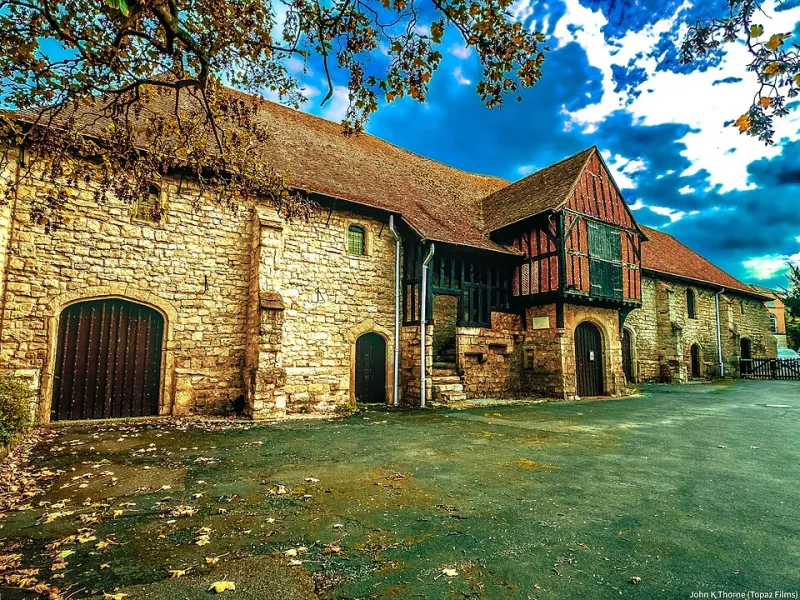
Photo: John K Thorne, Public domain, via Wikimedia Commons
The most important room in a growing class of American luxury homes contains no furniture at all. It may not even be attached to the main residence. It sits instead at the property's edge — a compact, often exquisitely detailed structure where a private drive meets the public road, and where, increasingly, the real business of estate living gets conducted.
The gatehouse is back. And in markets from Greenwich to Aspen to Montecito, it has evolved from a charming architectural afterthought into a fully programmed building that can command a seven-figure line item all its own.
From Folly to Function
The historical reference points are familiar to anyone who has driven past a Hudson Valley estate or a lowcountry plantation-style property: the lodges and gate lodges of the nineteenth century, miniature compositions of stone and slate that announced taste before a guest saw a single column of the main house. For decades, their modern descendants were largely decorative — a half-timbered hut with a phone, perhaps, or a printed sign with a family crest.
That era is over. Today's security pavilions are engineered buildings. They house dedicated electrical and low-voltage infrastructure, surveillance monitoring stations, climate-controlled equipment rooms, and in many cases fully self-contained staff apartments. Architects now speak of the gatehouse as a "threshold building" — the first and, in the eyes of some designers, the most important structure a visitor encounters.
"You're not designing a shed with a camera," one East Coast estate architect observes. "You're designing the entire tone of the visit in forty feet of facade."
What the Money Is Actually Buying
Strip away the romance and the gatehouse boom is a story about infrastructure — specifically, privacy infrastructure. High-net-worth buyers have become acutely conscious of exposure: physical, digital, and reputational. Personal security advisors now routinely participate in property searches, and their checklists read differently than a broker's.
A serious gatehouse program typically includes:
- Layered access control, from license-plate recognition at the road to biometric or credentialed entry at interior thresholds
- Dedicated monitoring space, allowing contracted security personnel to work on-site around the clock without entering the main residence
- Redundant systems, including backup power and communications, so the property's perimeter never goes dark
- Staff accommodation, converting the pavilion into a genuine residence for estate managers, house managers, or security teams
The last item deserves emphasis. In an era when a single trusted estate manager can be the difference between a smooth household and a revolving door, on-site staff housing has become a genuine negotiating asset. The gatehouse apartment — once the stuff of Downton Abbey fantasy — is now a practical recruiting tool.
The Choreography of Arrival
There is a second, less discussed driver behind the trend: the growing sophistication of what designers call arrival choreography. Luxury real estate has long understood that the approach sequence — gate, drive, motor court, entry — shapes how a property feels. The gatehouse is the opening note.
On the finest properties, that note is being composed with real care. Materials are drawn from the main house palette. Proportions are studied. Lighting is layered so that the structure reads as an architectural invitation at dusk rather than a checkpoint. The best examples manage a difficult trick: they make control feel like hospitality.
This is where the category splits. At one end sit the fortresses — unapologetically serious, often on sprawling Texas or Colorado ranchettes, where the pavilion is genuinely a security operations post. At the other end sit the subtle versions: a sculpted stone entry lodge in a gated Palm Beach community, or a cedar-and-glass pavilion on a Napa property, where the security program is almost entirely invisible and the architecture does the talking.
The Appraisal Question
For buyers and their advisors, the practical question is whether the investment returns. The evidence, anecdotally, suggests it does — unevenly. In legacy enclaves where gated estates are the norm, a property without controlled access can lag the market. In markets where it is rare, a well-executed gatehouse can be a differentiator that photographs beautifully and signals seriousness to a particular class of buyer.
Appraisers caution that such improvements are valued as part of the whole, not line by line. But brokers in the estate segment report that "true controlled access" — a staffed, engineered entry rather than a swing arm and a code box — is increasingly named in listing copy as a headline feature, alongside provenance and acreage.
Building for the Long View
The gatehouse renaissance says something larger about where American luxury is heading. The wealthiest buyers are no longer purchasing rooms; they are purchasing systems — of privacy, of service, of composure. The house for the house is simply the most visible expression of that shift, standing at the property line and quietly deciding who belongs.
Done well, it is also a reminder that the oldest ideas in estate architecture often turn out to be the most durable. The Gilded Age builders understood that a home begins before the home. A century later, their successors are proving it again — one stone lodge, one motor court, one carefully staged arrival at a time.