Still Water, Deep Money: The Reflecting Pool Returns as America's Most Serious Status Symbol
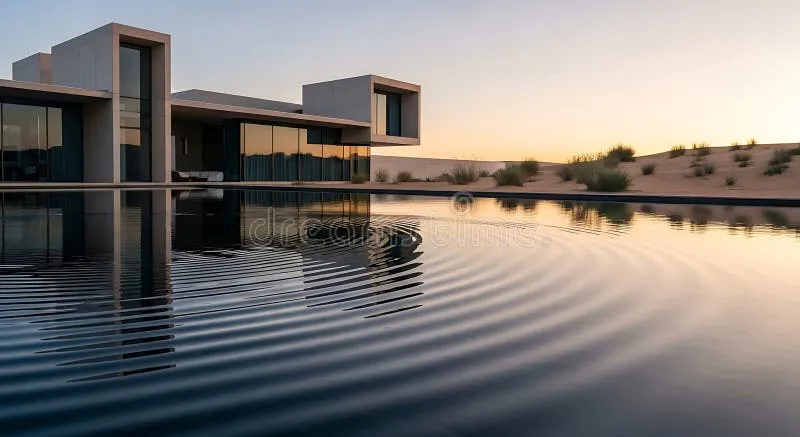
Photo: minimalist reflecting pool luxury modern house architecture dusk, via thumbs.dreamstime.com
There is a particular kind of luxury pool appearing across the American West and along both coasts that no one actually swims in. It sits level with a limestone terrace, holds perhaps eighteen inches of water, and does nothing — brilliantly. At dusk it doubles the facade of the house behind it. On windless mornings it disappears entirely, leaving only sky where a backyard used to be.
Designers have a name for the effect and a word for the ambition behind it. The reflecting pool, an element borrowed from Persian gardens, Mughal courtyards, and the Lincoln Memorial, has become the most quietly assertive feature in American residential architecture. And its resurgence says something worth listening to about how the wealthy now want their outdoors to behave.
From Recreation to Reflection
For most of the twentieth century, the American pool was a machine for activity. The postwar kidney shape, the diving board, the chlorine-blue rectangle of the Palm Springs estate — these were stages for living, built to be cannonballed into by children and photographed at pool parties. Water was for using.
The new water is for looking at. In high-end residential work from Aspen to Montecito, the pool has been repositioned as an optical instrument: a plane that extends the architecture, frames a ridge line, or holds the sky in place. Infinity edges, once a novelty, are now calibrated with millimetric precision so the water meets the horizon without a visible seam. Lap pools are being tucked into side yards and detailed like galleries — long, narrow, stone-lined corridors of stillness that read as sculpture whether anyone swims or not.
The shift is not aesthetic whim. It reflects a change in who is commissioning the work and how they intend to live.
The Acoustics of Calm
Ask landscape architects who serve this market what water is actually being specified for, and the answer is rarely recreation. It is sound. A blade of water spilling over a granite weir produces a frequency that masks traffic, neighbors, and the world beyond the hedge. A still pool, by contrast, produces silence — or the illusion of it.
Both registers are in demand. The reflecting pool offers visual quiet; the scupper and the rill offer aural privacy. Together they turn the garden into a controlled sensory environment, which is precisely what buyers paying eight figures believe they are purchasing. The water is not an amenity. It is a perimeter, drawn in sound and reflection instead of walls.
What the Mirror Reveals
There is an irony worth noting. The swimming pool — the great democratic emblem of California leisure, the symbol of a culture that celebrated play — has been made serious. A pool you cannot swim in is a pool that has surrendered its function to its image. It is architecture first, water second.
That surrender tracks with broader changes in luxury living. The primary suite outshines the kitchen. The wellness wing has replaced the cinema. Leisure itself has been replaced by its representation: spaces that photograph as retreats, whether or not anyone retreats in them. The reflecting pool is the purest expression of this — a body of water whose entire purpose is to double the value of whatever stands behind it.
And yet the best examples resist the cynicism. At their strongest, these pools recover something older and genuinely architectural: the understanding that water, handled with restraint, can do what no material can. It can make a building twice as present. It can hold light the way a room holds furniture. It can make a flat piece of Texas hillside or a narrow Malibu lot feel like an estate.
Specification as Philosophy
For buyers considering what the trade calls a 'water feature' — a term that undersells it badly — the questions worth asking have changed. How deep is it? (Shallower reads calmer, and photographs better.) What is the edge detail? (A coping stone that meets the water without a gap is the difference between a pool and a plane.) How is it maintained, heated, and lit? A reflecting pool that goes green in August is not a mirror; it is a liability.
The deeper question is the philosophical one. A pool for swimming announces that the owners play. A pool for reflection announces that they observe. In the current American market, observation — of a view, of a facade, of one's own good fortune — is the more valuable of the two.
The water has stopped moving. The money, evidently, has not.