The Quiet Return of the Parlor: Why America's Finest Homes Are Closing the Door on Open Concept
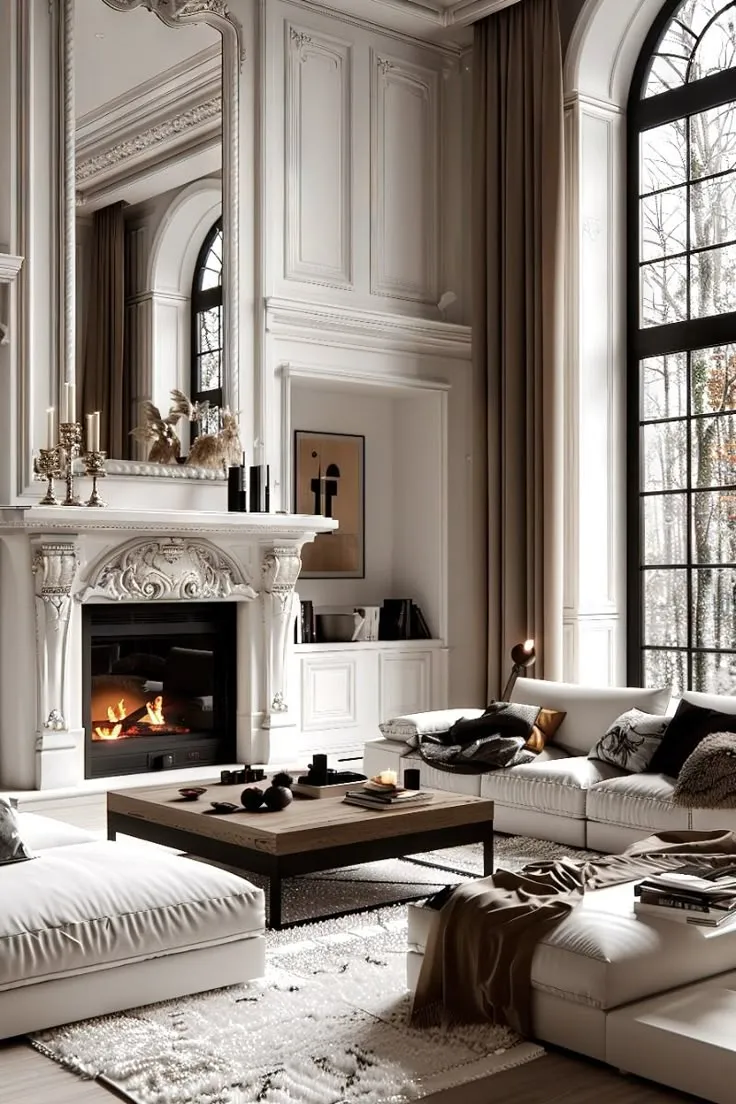
Photo: elegant formal living room parlor fireplace interior design luxury home, via i.pinimg.com
For nearly twenty years, the American luxury home has been organized around a single idea: openness. Walls came down, kitchens expanded into great rooms, and the formal living room — that dignified, seldom-used chamber of an earlier era — was written off as wasted square footage. In 2025, the pendulum is swinging back. Across new builds in Connecticut, Texas, and the Pacific Northwest, architects are once again drawing a distinct, enclosed parlor into their plans, and affluent buyers are asking for it by name.
The Fatigue of the Open Floor
The open-concept plan promised togetherness, and it delivered — perhaps too much of it. Cooking, homework, remote work, and television now share one uninterrupted acoustic and visual field. For households that host frequently or simply crave a moment of separation, the great room has become a place of low-grade chaos rather than repose.
The parlor answers that problem with architecture rather than gadgets. A door, a pocket of quiet, a room whose furniture faces inward toward conversation instead of outward toward a screen: these are luxuries that no soundbar or smart-glass retrofit can fully replicate. As one Dallas-based architect puts it, the most desirable amenity in the high-end market right now is "a room you can close."
A Room With a Purpose Again
What distinguishes the revived parlor from its dusty predecessor is intentionality. The Victorian parlor existed for ritual — calling hours, music, courtship. Its modern descendant is being designed around a narrower but equally clear brief: unhurried conversation, a glass of wine after dinner, an hour with a book.
In practice, this means a few consistent moves in new luxury plans:
- Proximity without exposure. The parlor typically sits adjacent to the main living areas but behind a threshold — French doors, a cased opening, a short vestibule — that signals arrival without isolation.
- Symmetry and ceiling presence. Coffered or plaster ceilings, matched sconces, and centered fireplaces give the room a ceremonial quality the open plan deliberately erased.
- Furniture arranged for talk. Four chairs, two sofas facing one another, no television. The absence of a screen is the room's defining feature and its strongest selling point.
- Controlled light. Layered drapery and transom windows let hosts modulate the atmosphere from afternoon to evening in a way a wall of glass never could.
Four Rooms, Four Regions
The revival is playing out differently across the country. In New Canaan, Connecticut, a recently completed shingle-style estate pairs its great room with a modest, oak-paneled parlor of barely 300 square feet — proof that the room's power lies in intimacy, not scale. The builder reports that buyers tour the house and linger there longest.
In the Hill Country outside Austin, a limestone modern ranch treats the parlor as a counterweight to its glass-walled living pavilion: solid walls, a single clerestory, and a fireplace carved into a monolithic chimney. The contrast is the point — one room performs for a crowd, the other shelters a handful.
A Charleston infill project takes a more historical route, restoring the traditional single-house side parlor with heart-pine floors and original proportions, then furnishing it with contemporary pieces. And outside Portland, Oregon, a Northwest contemporary build softens the concept entirely, using sliding shoji-inspired panels so the room can be sealed for dinner and opened for a party.
Designing Your Own
For buyers renovating rather than building, the parlor can usually be carved from existing square footage — a formal dining room that goes unused, a front living room that has become a pass-through. The principles translate directly:
- Establish a threshold. Even a simple pair of doors changes how the room is used and perceived.
- Commit to the no-screen rule. One exception undermines the entire premise.
- Choose materials that hush. Wool rugs, heavy drapery, plaster walls — the parlor should sound as calm as it feels.
- Light in layers. Sconces at conversation height, a dimmable central fixture, and candlelight do more than any recessed grid.
The larger lesson is architectural: luxury is increasingly measured not by how much space a house contains, but by how many distinct experiences it can offer. The open plan gave us one big room for everything. The parlor's return suggests that the next decade of American residential design will be about knowing when to close the door.